It's all about ...
plants


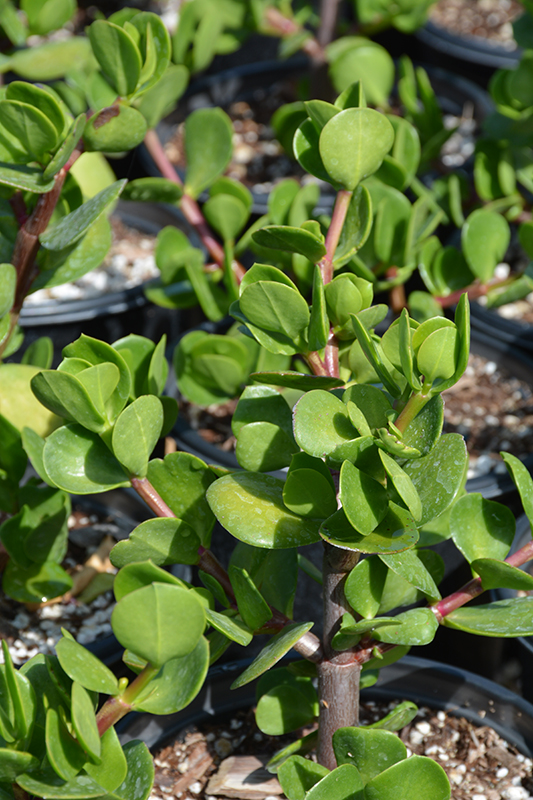
Large Leaf Elephant Food
Portulacaria afra 'Macrophylla'

Height: 10 feet
Spread: 7 feet
Sunlight:

Hardiness Zone: (annual)
Other Names: P. afra Mammoth, Elephant Bush, Porkbush
Description:
An upright plant with interesting reddish-brown stems, featuring widely spaced, large green leaves; grows large in frost free areas; popular use in bonsai; very drought tolerant and great for rock gardens or containers
Ornamental Features
Large Leaf Elephant Food is primarily valued in the landscape or garden for its ornamental upright and spreading habit of growth. It features dainty pink flowers with white overtones at the ends of the branches in early summer. Its attractive large succulent round leaves emerge light green in spring, turning dark green in colour throughout the season. The brick red stems are very colorful and add to the overall interest of the plant.
Landscape Attributes
Large Leaf Elephant Food is a multi-stemmed annual with an upright spreading habit of growth. It brings an extremely fine and delicate texture to the garden composition and should be used to full effect.
This is a relatively low maintenance plant, and can be pruned at anytime. Gardeners should be aware of the following characteristic(s) that may warrant special consideration;
- Insects
Large Leaf Elephant Food is recommended for the following landscape applications;
- Accent
- Mass Planting
- Rock/Alpine Gardens
- General Garden Use
- Container Planting
Planting & Growing
Large Leaf Elephant Food will grow to be about 10 feet tall at maturity, with a spread of 7 feet. It has a low canopy with a typical clearance of 1 foot from the ground. Although it's not a true annual, this slow-growing plant can be expected to behave as an annual in our climate if left outdoors over the winter, usually needing replacement the following year. As such, gardeners should take into consideration that it will perform differently than it would in its native habitat.
This plant should only be grown in full sunlight. It prefers dry to average moisture levels with very well-drained soil, and will often die in standing water. It is considered to be drought-tolerant, and thus makes an ideal choice for a low-water garden or xeriscape application. Like most succulents and cacti, this plant prefers to grow in poor soils and should therefore never be fertilized. It is not particular as to soil pH, but grows best in poor soils, and is able to handle environmental salt. It is highly tolerant of urban pollution and will even thrive in inner city environments. This is a selected variety of a species not originally from North America. It can be propagated by cuttings; however, as a cultivated variety, be aware that it may be subject to certain restrictions or prohibitions on propagation.
Large Leaf Elephant Food is a fine choice for the garden, but it is also a good selection for planting in outdoor pots and containers. Its large size and upright habit of growth lend it for use as a solitary accent, or in a composition surrounded by smaller plants around the base and those that spill over the edges. It is even sizeable enough that it can be grown alone in a suitable container. Note that when growing plants in outdoor containers and baskets, they may require more frequent waterings than they would in the yard or garden.